
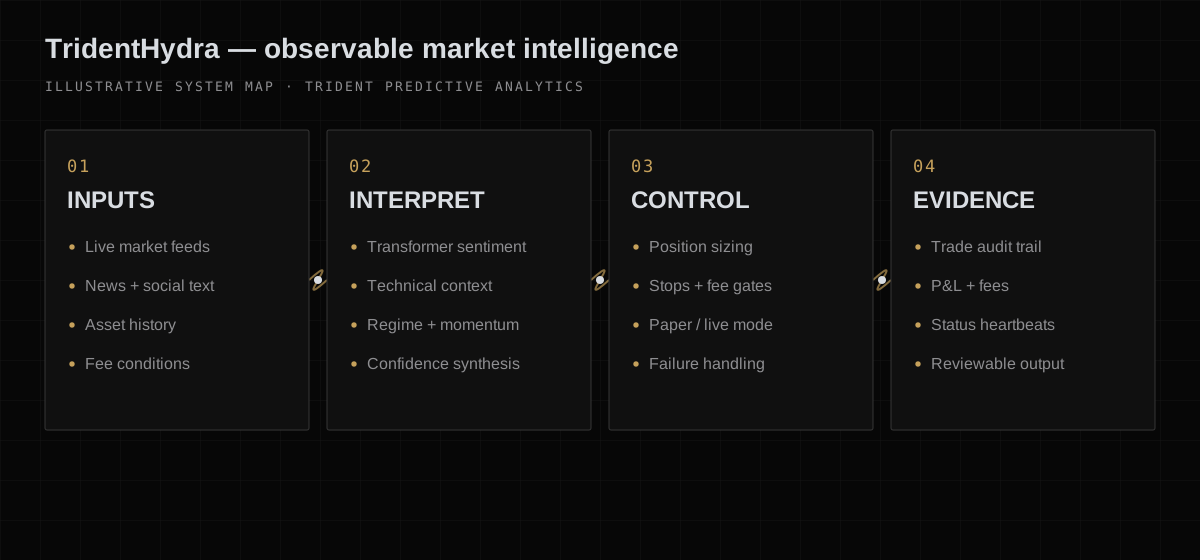
Market information arrives as a mixture of price movement, social narrative, news, fees, liquidity, and regime change. A useful system has to synthesize those signals without hiding the assumptions or pretending uncertainty has disappeared.
The problem
Many market dashboards present indicators beside one another and leave the user to mentally combine them. Automated systems often move in the opposite direction, collapsing the decision into a single opaque signal with no visible audit trail.
TridentHydra was built as a research and execution environment where sentiment, technical context, fee economics, risk controls, and reporting remain inspectable.
The constraints
Real-time inputs
Prices and text signals arrive continuously and fail in different ways.
Risk before excitement
Position size, fee conditions, stops, and execution mode must remain explicit.
Transparent operation
Trades, confidence, fees, and P&L need a visible record rather than a black-box result.
Recoverability
Async loops, data buffers, and external feeds must fail and restart without corrupting state.
The system
The platform integrates multi-source price and text ingestion, local transformer-based sentiment scoring, technical filters, configurable thresholds, fee-aware throttling, dynamic risk controls, paper-versus-live execution modes, HMAC-signed order handling, and itemized analytics.
Its modular architecture separates feeds, strategy, fees, execution, and P&L reporting so individual components can be tested or replaced without rewriting the entire system.
A decision system becomes more credible when it can show what it saw, what it assumed, what it did, and what it cost.
Use boundary
This case study demonstrates software architecture and quantitative research. It does not present investment advice, a managed strategy, or a claim of future profitability. Any live-market use carries risk and requires independent evaluation.
Relevant applications
Market intelligence
Unify narrative, price, risk, and execution context into one reviewable environment.
Event monitoring
Track changing sentiment and market response around assets, sectors, products, or public events.
Decision dashboards
Expose confidence, costs, risk state, and audit history instead of a single unexplained score.
Resilient automation
Apply the same observable, restart-safe architecture to other real-time systems.
What the project demonstrates
TridentHydra demonstrates real-time data engineering, local NLP inference, asynchronous orchestration, risk-aware automation, configurable architecture, and the discipline required to make an automated system explain itself.
Status: active research system and private technical demonstration.