
Generative visual work is often treated as decoration. Trident’s interface studies use it as research into perception, interaction, performance, atmosphere, and how a system can communicate without becoming a dashboard.
The problem
Many digital experiences have either technical depth or visual character. The difficult territory is work that remains responsive, controllable, and legible while also feeling alive.
The collection began as a series of standalone experiments and grew into a library of reusable behaviors, visual engines, interaction patterns, and licensable experience concepts.
The constraints
Performance
Particles, trails, blur, bloom, depth, and procedural detail must remain inside browser and device limits.
Coherence
Motion and color need a compositional logic rather than random visual abundance.
Interaction
Input should change the system in ways the viewer can understand and learn.
Portability
Experiments become more valuable when they can be embedded, branded, licensed, or adapted.
The system
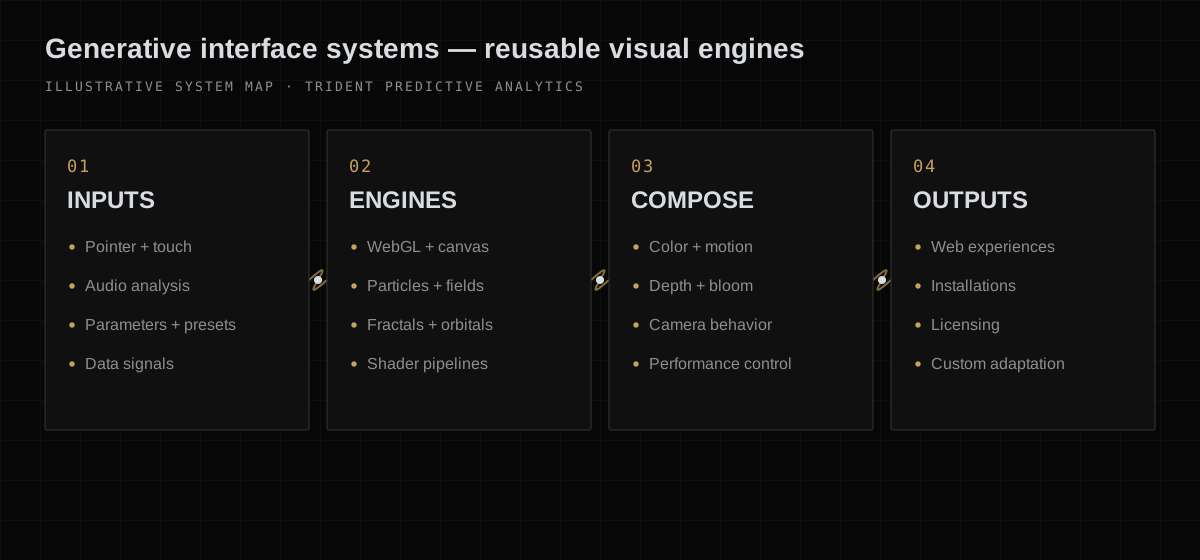
The catalog includes WebGL, canvas, orbital, geode-like line systems, fractal environments, particle fountains, audio-reactive scenes, procedural color behavior, camera breathing, depth-of-field effects, palette controls, and export or presentation modes.
Some studies are pure visual research. Others have become components inside MoodHz, scientific visualization, presentation systems, and future exhibit concepts.
The useful asset is not one animation. It is a vocabulary of tested behaviors that can be recombined around a new brief.
Use boundary
The systems are original studio research and are presented as creative-technology capability. Licensing, adaptation, and commissioned use depend on the specific engine, audience, platform, and rights required.
Relevant applications
Brand environments
Distinctive hero systems, installations, event displays, and premium digital touchpoints.
Music & performance
Audio-reactive and atmospheric visuals for artists, venues, and live or recorded work.
Scientific storytelling
Visual vocabularies that make invisible forces, fields, relationships, or scales perceptible.
Product licensing
Adapt existing engines into themed, branded, or embedded experiences.
What the project demonstrates
The library demonstrates sustained creative coding across rendering, interaction, procedural design, audio, performance optimization, visual composition, and the conversion of experiments into reusable technical assets.
Status: active collection and licensing inventory.