
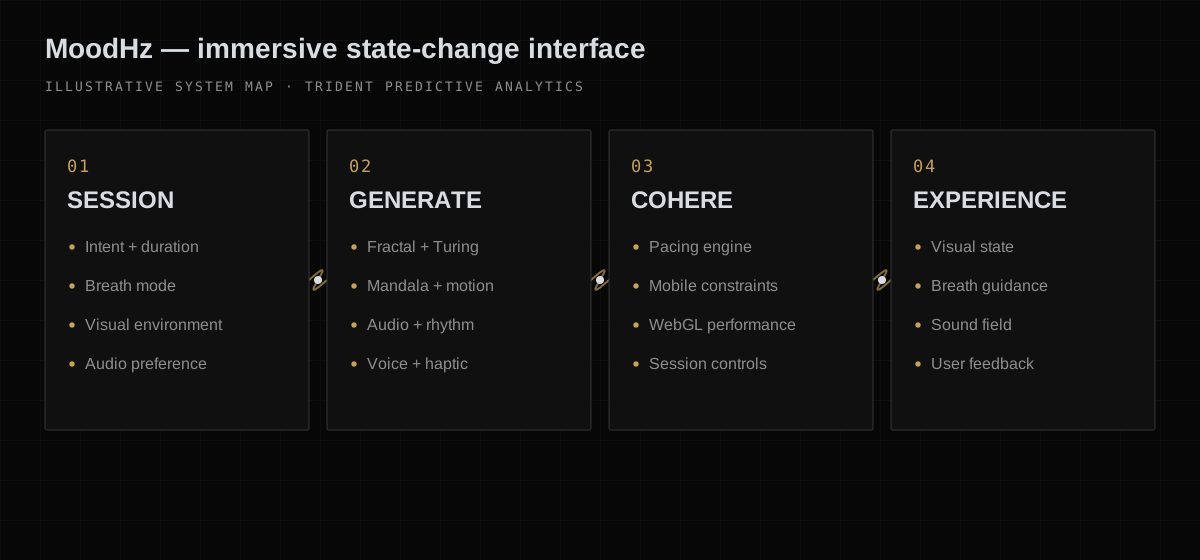
Most meditation products are libraries of recordings. MoodHz began from a different question: can visual motion, sound, breath pacing, rhythm, and interaction become one responsive instrument for changing the felt texture of a moment?
The problem
State-change experiences often separate the senses: a spoken track over a static screen, a timer without atmosphere, or a visualization with no physiological pacing. The result may be useful, but rarely feels like one coherent system.
MoodHz was designed as an immersive environment where the interface itself participates in the session.
The constraints
Immediate access
The experience must begin quickly in a browser or installable web app without complex setup.
Multi-sensory coherence
Visuals, breath timing, voice, audio, and haptics should reinforce rather than compete.
Mobile reality
Audio policies, voice support, GPU limits, and screen geometry vary significantly across devices.
No medical overclaim
The product can support a personal ritual without presenting itself as treatment or diagnosis.
The system
The application combines generative Mandelbrot exploration, Turing-pattern and mandala environments, breathing guidance, physiological-sigh and box-breathing modes, binaural or isochronic audio concepts, voice prompts, haptic cues, and responsive visual pacing in a progressive web application.
Building it required work across GPU initialization, WebGL behavior, audio pause and resume, mobile voice support, content security policy, caching, and the visual artifacts that appear during deep procedural zoom.
The product is not a content shelf. It is an instrument whose screen, sound, timing, and control surface must feel like one body.
Use boundary
MoodHz is an experimental wellness and immersive-interface product. It is not a medical device, therapy, or substitute for professional care. Public claims should remain grounded in experience design rather than health outcomes.
Relevant applications
Premium wellness
Distinctive visual and audio sessions for a product that does not resemble a generic meditation catalog.
Hospitality & retreat
Ambient guided experiences for rooms, spas, lounges, or transition spaces.
Installations
Responsive state-oriented environments for exhibitions, events, and cultural programs.
Licensing & adaptation
Branded versions, selected visual engines, or custom sessions built from the underlying system.
What the project demonstrates
MoodHz demonstrates product thinking across creative code, WebGL, audio, mobile constraints, interaction design, emotional pacing, and the conversion of a personal concept into a near-launch software experience.
Status: beta / launch preparation.